





- By Admin
- 04 Jul, 2026
What Kids Learn Through Play Activities
At Happy Feet, we believe childhood should be full of joy, movement, imagination, and discovery. A child does not learn only by sitting and listening. A child learns by touching, trying, building, imagining, sharing, and exploring. That is why educational activities for kids are such an important part of early learning.
When children take part in play activities, they do much more than have fun. They learn how to think, how to speak, how to solve problems, how to work with others, and how to feel confident in their own abilities. This is the heart of play-based learning, and it is one of the best ways to support a child in the early years.
In today’s world, many parents look for a school that does more than teach letters and numbers. They want a safe place where their child can grow with care, curiosity, and happiness. They want a place where learning feels natural and not forced. That is exactly why educational activities for kids matter so much.
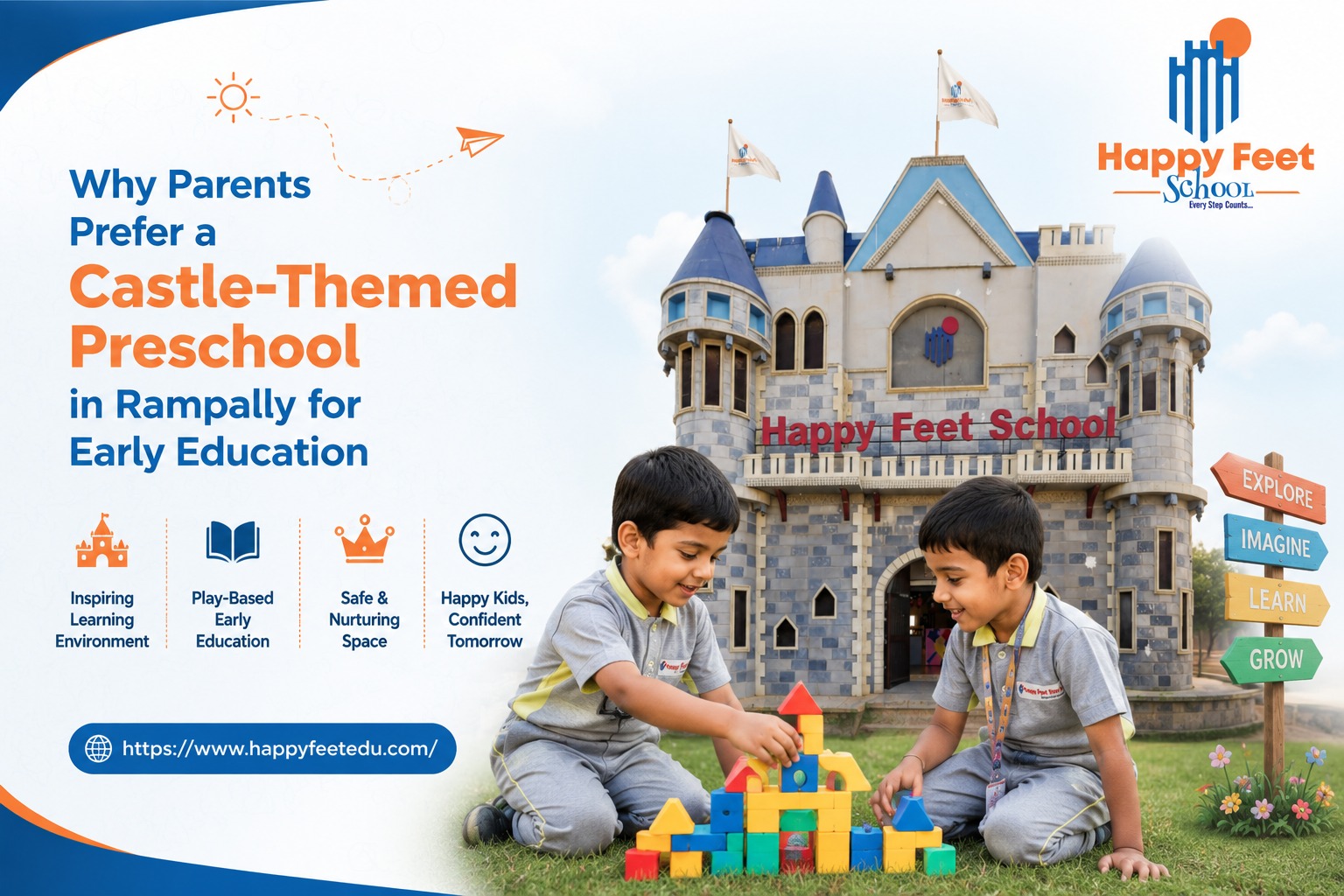
At Happy Feet, Hyderabad’s first castle-themed school, children learn through creative play, hands-on tasks, and guided experiences that build strong early skills. These activities are not just “extras.” They are the foundation of a child’s future learning.
If you are exploring a child-friendly and joyful start to schooling, you can also visit our Happy Feet preschool and see how our learning environment supports early growth. You can also explore more parenting and school readiness ideas on our Happy Feet blog.
Why Play is a Powerful Way to Learn
Play is one of the most natural ways for young children to learn. When a child plays, the brain becomes active. The child observes, compares, remembers, imagines, and responds. This helps build strong thinking skills without pressure.
A child who plays with blocks learns about balance and shape. A child who pretends to be a doctor learns about language and role play. A child who paints learns about colours and self-expression. A child who plays with friends learns sharing and patience. Every small play moment teaches something valuable.
This is why educational activities for kids should never be seen as only entertainment. They are powerful learning experiences. In fact, many of the most important early skills grow through play long before formal writing or textbook learning begins.
Play also helps children stay interested. When learning is fun, children naturally pay attention for longer. They remember better. They enjoy school more. They become active learners instead of passive listeners. That is the real strength of play-based learning.
What Kids Learn Through Play Activities
Children learn many things at the same time through play. Some lessons are easy to notice, like counting objects or naming colours. Some are less visible, like patience, focus, and self-control. Both are important.
Here are the main things children learn through educational activities for kids:
1. Language and Communication Skills
When children sing, talk, ask questions, listen to stories, or play pretend games, they learn language naturally. They hear new words. They learn how to speak clearly. They start using longer sentences. They also learn how to listen to others.
For example, when two children play in a toy kitchen, they may say things like, “I am cooking rice,” or “Please give me the spoon.” These simple lines build vocabulary and communication skills.
Story time, rhyme time, and role play are strong educational activities for kids because they help children express their thoughts and feelings. This is very helpful for school readiness and social growth.
2. Social Skills and Friendship
Children need to learn how to be with others. Play helps them do that. In a group activity, they learn to wait, share, take turns, and work together. They begin to understand that other children also have ideas and feelings.
This is one of the biggest benefits of play-based learning. A child learns how to join a group, follow simple rules, and respect others. These are not just school skills. They are life skills.
When children play together, they also learn how to handle small conflicts. For example, if two children want the same toy, they learn to solve the problem with help. This builds social maturity and emotional balance.
3. Thinking and Problem Solving
Many play activities help children think deeply without making them feel stressed. Puzzles, building blocks, sorting games, matching cards, and simple treasure hunts all improve brain power.
A child who builds a tower learns what makes it fall and what makes it stay strong. A child who puts shapes into the right box learns matching and reasoning. A child who completes a puzzle learns patience and planning.
These are strong educational activities for kids because they build the child’s ability to observe, guess, test, and solve. This kind of learning supports later skills in maths, reading, and science.
4. Creativity and Imagination
Children have rich imaginations. Play gives them space to use it. Drawing, painting, pretend play, clay modelling, costume play, and storytelling help children create their own ideas.
When a child imagines a cardboard box as a car, a shop, or a spaceship, the mind becomes more flexible. This supports creative thinking, which is useful in school and in life.
At Happy Feet, creativity is not treated as a side activity. It is part of daily learning. We believe educational activities for kids should help children dream, make, build, and explore with confidence. This is one of the strongest parts of play-based learning.
5. Fine Motor Skills
Fine motor skills are the small hand and finger movements children need for writing, cutting, holding objects, and dressing themselves. Many play activities help build these skills.
Some good examples are:
-
clay work
-
paper tearing
-
colouring
-
bead stringing
-
stacking
-
tracing
-
sorting small objects
These educational activities for kids make the hands strong and ready for writing later. They also improve hand-eye coordination. This is important because a child must learn control before they learn neat handwriting.
6. Gross Motor Skills
Gross motor skills use the large muscles of the body. Running, jumping, dancing, climbing, balancing, and stretching all help children grow physically strong.
Outdoor play and movement games are important because children need to move. Movement helps balance, posture, and body awareness. It also helps children feel fresh and active.
A child who moves well usually feels more confident. That is why active educational activities for kids are a key part of early development. They support both the body and the brain.
7. Focus and Attention
Young children do not always sit still for long periods, and that is normal. But through guided play, they slowly learn to focus for longer. A puzzle, a matching game, a story, or a pattern activity helps build attention.
When a child finishes a task, they learn to stay with one activity until it is done. This is a very important school skill. It prepares children for classroom routines and later academic work.
Good play-based learning gives children chances to practise focusing calmly and enjoyably.
8. Confidence and Independence
Children feel proud when they do something on their own. Whether it is putting toys back, tying an apron, answering a question, or finishing a drawing, every small success matters.
Play activities help children trust themselves. They learn, “I can do it.” This is one of the best gifts early education can give.
Confidence grows when children are allowed to try, make mistakes, and try again. That is why educational activities for kids should create a safe place for learning. Children grow best when they feel supported, not rushed.
9. Early Math and Logic Skills
Math starts long before formal numbers. Children learn math through sorting, counting, comparing, matching, and pattern making.
For example, children may:
-
count blocks
-
group toys by colour
-
compare big and small objects
-
follow simple patterns
-
identify shapes
These activities make maths feel easy and fun. They help children understand basic logic practically. This is why educational activities for kids are so important in preschool years. They build a strong base for future learning.
10. Emotional Growth
Children also learn about emotions through play. They feel joy, excitement, frustration, pride, and disappointment. With the right support, they learn how to manage these feelings.
For example, if a child loses a game or waits for a turn, they learn patience. If they help a friend, they learn kindness. If they tell a story about how they feel, they learn self-awareness.
Emotional growth is a major part of play based learning. Children who understand their feelings are better able to learn, connect, and adapt.
Important Activities Every Young Child Should Experience
Not all activities need to be complicated. Simple, repeated, and meaningful activities work best for young children. Here are some of the most important educational activities for kids that support strong development.
Story Time
Stories build listening, vocabulary, imagination, and memory. They also help children learn about daily life, values, and behaviour. A good story can teach more than one lesson at a time.
Music and Rhyme Time
Songs and rhymes help children hear sounds, learn new words, and remember patterns. Music also supports rhythm, attention, and joy in learning.
Art and Craft
Drawing, painting, glueing, folding, and colouring all build creativity and fine motor skills. These activities help children express ideas even before they can write full sentences.
Pretend Play
Pretend play is one of the strongest forms of play-based learning. Children can pretend to be teachers, doctors, shopkeepers, parents, or superheroes. Through these roles, they learn language, social behaviour, and problem-solving.
Outdoor Play
Running, jumping, climbing, ball games, and free movement help children grow physically strong. Outdoor play also teaches teamwork and self-control.
Sorting and Matching Games
These games help children learn logic, shape, colour, size, and pattern recognition. They are simple but very useful educational activities for kids.
Hands-On Exploration
Touching, building, pouring, scooping, and comparing materials help children learn by doing. Hands-on learning is one of the best ways to make early education real and meaningful.
Why Parents Should Choose Play-Based Learning
Many parents ask whether play is really enough for learning. The answer is yes, when it is planned well and guided with care. Children do not learn less through play. They often learn more because they are active, curious, and involved.
Play-based learning helps children build strong early skills without pressure. It gives them a love for learning. It also helps them become more independent, more social, and more confident.
Parents who choose educational activities for kids in a school setting are giving their children a strong start. Instead of forcing memorisation too early, they are helping children learn naturally. This can make a big difference in how a child feels about school in later years.
At Happy Feet, we see learning as a full experience. Children are not just students. They are explorers, creators, thinkers, and little problem solvers. Our castle-themed environment adds wonder to every day, making learning feel special, warm, and memorable.
How Happy Feet Supports Early Learning
Happy Feet focuses on more than academics. We support the full growth of a child. That means learning with joy, building trust, and giving each child the care they need.
Our approach includes:
-
safe and loving spaces
-
personalised care
-
guided educational activities for kids
-
strong parent partnership
-
hands-on and activity-based learning
-
a joyful castle-themed environment
Children learn best when they feel secure and valued. That is why our learning style is designed to support the whole child. We want children to grow in confidence, creativity, communication, and curiosity.
When parents look for a school, they often ask, “Will my child be happy here?” That question matters. A happy child learns better. A child who feels safe is more open to exploring. A child who enjoys school is more ready to grow.
That is the power of play-based learning in the right environment.
What Makes an Activity Truly Educational?
An activity becomes educational when it has a purpose beyond keeping a child busy. It should help the child learn something new, practise a skill, or build a habit.
A strong activity is:
-
simple
-
age appropriate
-
hands on
-
safe
-
fun
-
meaningful
For example, a colour sorting game teaches more than colours. It teaches focus, matching, and following instructions. A pretend market activity teaches language, social skills, and thinking. A story session teaches listening and memory.
This is why smart educational activities for kids are planned with care. They are playful, but they are also purposeful.
How Parents Can Support Learning at Home
Learning does not stop at school. Parents can help children grow through simple home activities too.
You can:
-
read stories every day
-
ask your child to name objects around the house
-
let them help with small tasks
-
encourage drawing and colouring
-
play sorting and matching games
-
allow pretend play
-
talk about feelings
These small moments count. They support play based learning and help children feel that learning is part of everyday life.
The best thing parents can do is stay involved. Children feel more secure when school and home work together. That is one reason parent partnership is so important at Happy Feet.
Final Thoughts
Children learn best when they are active, curious, and free to explore. Through educational activities for kids, they build language, confidence, thinking skills, social skills, motor skills, and emotional strength. Through play based learning, they enjoy the process of learning while building a strong base for the future.
A child does not need pressure to grow. A child needs the right environment, the right guidance, and the right kind of activities. When learning feels safe and joyful, children stay open, creative, and ready for more.
At Happy Feet, we believe every play moment can become a learning moment. That is why our castle-themed school is built to support children through care, imagination, and hands-on discovery. If you are looking for a school where your child can learn, grow, and feel truly seen, Happy Feet is ready to welcome you.
FAQs
1. What are educational activities for kids?
Educational activities for kids are fun learning tasks that help children build skills like speaking, counting, problem-solving, creativity, focus, and social behavior.
2. Why is play-based learning important?
Play-based learning helps children understand ideas naturally. It keeps them active, interested, and confident while they learn through doing.
3. What do children learn through play activities?
Children learn language, friendship, sharing, patience, thinking, movement, imagination, and emotional control through play activities.
4. Are play activities enough for preschool children?
Yes, when the activities are planned well. Play activities can teach early reading, maths, communication, and life skills in a simple and effective way.
5. How does Happy Feet support child development?
Happy Feet supports child development through a safe environment, personalised care, hands-on learning, parent partnership, and joyful educational activities for kids.